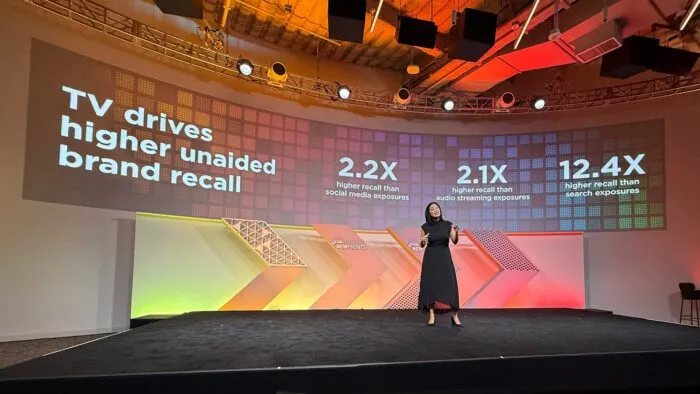
For years, TV’s job was clear: build brands, create awareness, and make people feel something. But as connected TV continues to mature, that role is expanding. CTV, or streaming, is no longer viewed only as a powerful awareness channel; it is increasingly expected to deliver measurable business impact, too.
That shift was at the center of the Advertising Week New York panel, CTV’s Performance Revolution: From Brand Building to Measurable Business Impact, where I got the chance to sit down with leaders from Upwave, Inmobi, Premion, and the VAB to explore how advanced measurement, deterministic data, and addressable capabilities are reshaping what marketers can expect from TV.
CTV is becoming easier to measure, but marketers still need proof of ROI
One of our panel’s early themes was the progress that TV in all its forms has made on measurement. Recent research from Comcast Advertising supports this, finding that 62% of marketers say CTV is easier to measure today than it was two years ago.1 That progress matters because performance has always been part of TV’s value; what has changed is the ability to better quantify it.
Still, measurement advancements do not automatically unlock more spend. ROI remains a barrier, especially as marketers face greater pressure to prove that media investments are driving outcomes. The opportunity now is to connect CTV’s, as well as traditional TV’s, historic strength in brand building with clearer signals of business impact, from incremental reach to website activity, sales, repeat purchases, and loyalty.
Performance starts long before conversion
A recurring question throughout the conversation was whether the industry has become too focused on the final conversion window. As the group emphasized, there is much more to the story than what happens immediately before a purchase or action. The brand-building work that happens earlier in the journey helps create the familiarity, trust, and loyalty that make conversion possible, and TV is uniquely effective at capturing the attention that helps viewers make memories.
In other words, performance does not begin at the click, the visit, or the sale. It begins when a brand becomes easier to remember, easier to trust, and ultimately easier to choose.
Brand and performance should be a unified strategy
Another major takeaway was the need to retire the idea that brand and performance sit on opposite sides of the marketing plan. As one of the panelists pointed out, ad experiences contribute to the full consumer journey. A campaign may create emotion, prompt consideration, encourage engagement, and eventually drive an action such as a purchase, download, or store visit. In fact, Comcast Advertising’s latest report found that multiscreen TV campaigns generate 2.4X more website visits than campaigns using a single tactic.2
That does not mean every creative asset should do every job. In fact, we collectively emphasized the opposite: marketers need to think carefully about the role of each message and experience. Creative designed to build emotion may look different from creative designed to drive an immediate sale, but both can contribute to the same business outcome when planned as part of a connected strategy.
The consumer journey is no longer linear, making early influence even more critical
The panel also underscored how much the consumer journey has changed. Discovery, consideration, and purchase are no longer neatly sequenced steps. Consumers encounter brands across platforms, screens, and touchpoints, and emerging behaviors, including AI-assisted discovery, are making those paths even more complex.
That complexity creates a larger role for CTV. By reaching audiences in premium, lean-back environments while also enabling more precise targeting and measurement, CTV can help brands insert themselves earlier in the conversation and create the kind of memory structures that influence both current and future demand.
Optimization should support the overall campaign strategy
With more data available, marketers can now understand which audiences, environments, and messages are driving results. The growing ability to optimize based on which audiences work best for specific advertisers and verticals is helping connect campaign activity to outcomes through stronger signals and match backs.
But marketers do not need to optimize everything they measure. The goal should be to use data as an input for better decision-making, not to overcorrect toward only the most immediate or easily attributable actions. TV works best when it makes a product both easy to remember and easy to buy; TV’s next chapter is about bringing digital accountability to that broader value proposition.
What marketers should know about CTV performance
If there was one clear call to action from the panel, it was this: marketers need to embrace CTV’s versatility. That means looking beyond a single metric or outcome and recognizing that CTV can help drive both immediate and long-term impact. It can support reach and awareness, build memory and trust, retarget audiences in environments where they can take action, and provide data that helps advertisers continuously improve.
Most importantly, this conversation cemented the fact that marketers should stop choosing between brand and performance. In the new CTV environment, the stronger opportunity is to plan for both: using the sight, sound, and motion of TV to create demand, while applying better data and measurement to understand, optimize, and prove its impact.
To learn more about multiscreen TV drives outcome and performance at every stage of the buyer journey, download Comcast Advertising’s latest Multiscreen Performance Report.
Source
1. AdExchanger survey commissioned by Comcast Advertising, November 2025.
2. Comcast Advertising, Multiscreen Performance Report 1H 2026, Oct 2026.